

From the outset of the electronic invoicing reform, Houdart A&C anticipated the technical implications of the regulation, developed the appropriate action plans to establish a comprehensive process flow mapping incorporating an approved platform for both invoice receipt and issuance, and built in-depth expertise across the available market solutions in order to help our clients identify turnkey or open-source software solutions that can be adapted to their organizational constraints and operational requirements.
Regardless of the complexity of your organizational structure, Houdart A&C supports you in the implementation or evolution of your digital environment to ensure regulatory compliance while making it a driver of your entity’s economic performance.
Principles of electronic invoicing
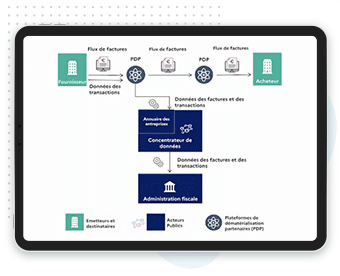
The electronic invoicing reform aims to generalize the digitization of invoice exchanges between businesses in order to enhance transaction reliability, automate accounting processing, and strengthen the fight against VAT fraud.
The companies concerned must be able to:
- Receive electronic invoices via a Partner Dematerialization Platform (PDP) certified by the tax authorities;
- Issue invoices in a structured format (Factur-X, UBL, or CII), enabling automated data processing;
- Transmit invoicing and payment data to the tax authorities as part of the e-reporting framework (B2C flows, international transactions, advance payments, and collections).
Knowing how to capitalize on this obligation to transform it into an opportunity
Beyond mere regulatory compliance, electronic invoicing presents an opportunity to transform financial processes:
- automation of the Purchase-to-Pay (P2P) and Order-to-Cash (O2C) chains,
- improved reliability of accounting data,
- enhanced cash flow forecasting,
- secure internal approval and validation processes.
The success of this transformation hinges on a thorough understanding of your existing organization, your tools, your validation workflows, and the interactions between your various internal and external stakeholders.
It is precisely this hands-on approach that Houdart A&C provides: ensuring compliance while leveraging digitalization to drive operational performance.
The Nature of Our Engagement
At Houdart Audit & Conseil, our approach is pragmatic, independent, and fully aligned with our clients’ operational realities. We intervene across three main engagement scenarios, depending on your level of digital maturity and your organizational requirements.
Case 1 – Deployment of a Turnkey Solution
For agile organizations without an ERP system and seeking rapid implementation, we support the deployment of solutions such as MyUnisoft Financial Management or Libeo.
Our engagement covers the entire framework:
- Analysis of your existing processes (invoicing, purchasing, approval, payment);
- Configuration of the solution according to your operating model (business partners, analytical structures, approval workflows, user management);
- Implementation of validation workflows;
- Operational training for your finance and administrative teams.
This approach enables full automation of the Purchase-to-Pay (P2P) and Order-to-Cash (O2C) cycles, ensuring regulatory compliance, audit trail traceability, and real-time financial steering.
Case 2 – Adaptation of Your Existing Process Flows and Workflows
Some organizations already operate business applications, ERP systems, invoice generation platforms, approval workflows, and document management systems (DMS) which, although mature and capable of handling Factur-X formats, were not initially designed to integrate with an approved platform. These systems nonetheless constitute a structured flow environment that supports internal control requirements and must be preserved.
In this context, our engagement consists of:
- Precisely mapping all current flows and validation steps:
- from purchase order to invoice,
- from supplier receipt to accounting integration,
- internal approval cycles through to payment;
- Assessing the regulatory compliance of these flows under the reform;
- Identifying the necessary adaptations:
- integration of a PDP,
- evolution of invoice formats,
- interfacing existing applications,
- reinforcement of internal control procedures;
- Designing an optimized digital target model that respects both your organizational constraints and performance objectives;
- Supporting you in identifying software publishers whose solutions can be adapted to your existing architecture.
We then manage the implementation of these changes in coordination with your internal teams and IT service providers, through to full validation of the flows in live operating conditions.
Case 3 – Partial Adaptation of your Invoice Issuance and Generation Architecture
Some agile organizations with relatively simple structures are able to adapt part of their processes—typically the Purchase-to-Pay cycle—but have designed or rely on business-critical applications that are deeply embedded in their operations, sometimes difficult to replace, and not natively connected to an approved platform. This is typically the case for certain start-ups or regulated professions.
In this context, the objective is to:
- Deploy a compliant solution for the portion of the process that can be addressed through the implementation of a new operational solution without major changes to existing internal workflows;
- Analyze the technical gaps between existing business applications and approved platform requirements for the components that can only be adapted rather than replaced;
- Identify the necessary developments and control checkpoints required to bring the flows into compliance and make the solution API-connectable to an approved platform;
- Engage with approved platform vendors to identify the solutions best suited in terms of functionality and cost.
We then support the required developments in close coordination with your internal teams and IT service providers, through to full validation of the end-to-end flows in live operating conditions.
With Houdart Audit & Conseil, electronic invoicing support goes beyond regulatory compliance. It represents a comprehensive approach to structuring, securing, and optimizing your financial processes, transforming a regulatory constraint into an opportunity to strengthen process reliability, internal control, and the timeliness of key management information—ultimately making it a lever for operational performance.