

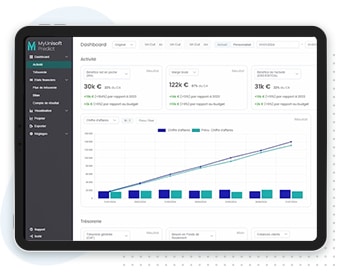
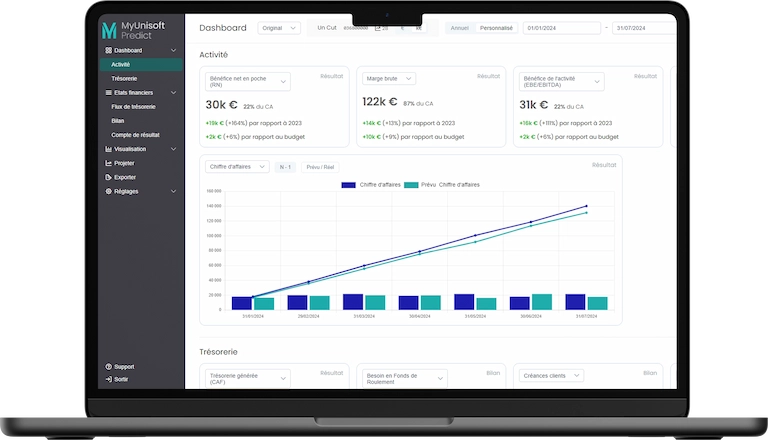
MyUnisoft features a dedicated module enabling the rapid generation and continuous updating of forecasts and projected results, based on the centralized financial data available within the platform (purchasing, invoicing, payroll, treasury, etc).
Regardless of the complexity of your organization, Houdart A&C supports the implementation or evolution of your digital environment to ensure regulatory compliance while making it a driver of your entity’s economic performance.
MyUnisoft Financial Steering
The data collected within MyUnisoft is securely integrated into MyUnisoft Financial Steering via API connectivity. The solution processes the data in order to determine the algorithms that explain historical trends, generate financial forecasts, and build forward-looking projection scenarios.
Monthly, quarterly, or annual projected results (“landing forecasts”) can be produced in order to refine projections, analyze variances, and draw operational conclusions for the financial steering of your business.
Forecasting Methodologies
The preparation and continuous updating of forecasts at each landing cycle combine statistical methods and artificial intelligence models, as detailed in our dedicated publication.
The statistical component is primarily based on the SARIMA methodology, an extension of the ARMA model, which is particularly suited to modeling time series with seasonal components and is defined by seven parameters.
Accounts whose trends are more complex to identify are processed using neural networks in order to determine future developments based on projected variations in correlated accounting line items.
The AI component relies on neural networks and an optimized number of training epochs in order to avoid excessive corrections to projected variations. Neural network training is the process by which the artificial intelligence system builds a predictive model from historical data. In the context of predictive accounting, the training dataset consists of complete fiscal years preceding the period submitted for projection.
In order to optimize both the quality of the calculated projections and the associated resource and processing costs, accounts with more straightforward trend patterns are primarily generated using statistical rules
Accounts whose trends are more complex to identify are processed using neural network models in order to determine future developments based on the projected variations of other correlated general ledger accounts.
Analytical and Critical Review by Our Teams
However, for artificial intelligence to be fully effective, it must be complemented by critical analysis from both the chartered accountant and company management. Certain qualitative elements are not reflected in the historical datasets used for model validation and are known only to these stakeholders. Once the initial analytical review of the raw projections has been completed, the chartered accountant and management adjust any elements requiring refinement. The data is then resubmitted to the AI engine in order to update any correlated accounts accordingly.